Download the HPLC Calculator App: The Ultimate HPLC Analysis Tool

Your expert companion for HPLC method development, liquid chromatography troubleshooting, and calculating parameters for both RP-HPLC and UPLC systems.

Get instant access to advanced HPLC calculations and community support

113
Questions Asked
72
Answers Given
518
Community Members
0
Questions Today
Questions
Question image

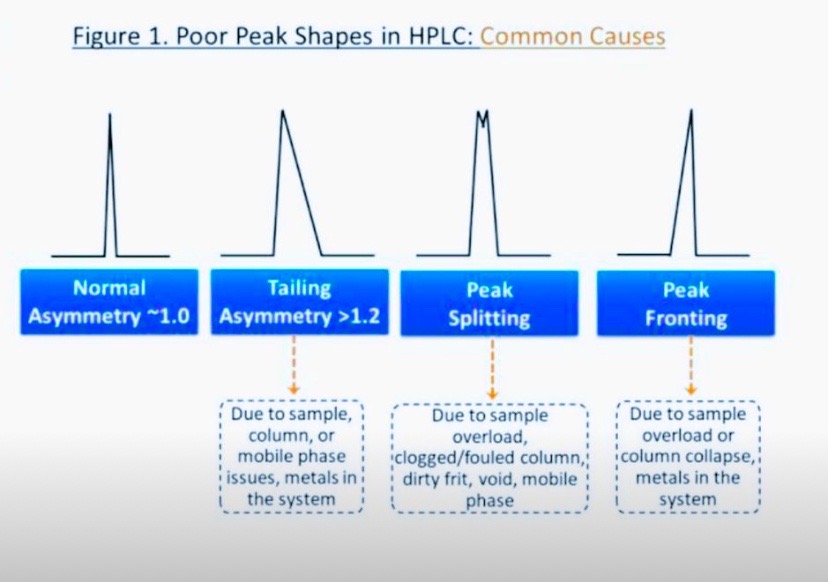
1. Column Maintenance:
Regular column cleaning: Clean the column regularly to remove contaminants.
Column regeneration: Regenerate the column according to the manufacturer's instructions.

2. Mobile Phase Optimization:
pH adjustment: Adjust the pH of the mobile phase to optimize the ionization state of the analyte.
Buffer concentration: Optimize the buffer concentration to reduce ionic interactions.
Organic modifier: Adjust the type and concentration of organic modifier.

3. Sample Preparation:
Sample cleanup: Clean up the sample to remove impurities that may cause tailing.
Sample solven: Use a sample solvent that is compatible with the mobile phase.

4. Column Selection:
Choose the right column: Select a column that is suitable for the analyte and mobile phase.
Column type: Consider using a column with a different bonding chemistry or particle size.

5. Instrument Optimization:
Injector optimization: Optimize the injector settings to reduce sample dispersion.
Detector settings: Adjust the detector settings to optimize peak shape.

6. Method Optimization:
Gradient optimization: Optimize the gradient to improve peak shape.
Flow rate: Adjust the flow rate to optimize peak shape.

192 views

No answers yet.

Frequently Asked Questions: HPLC Analysis & Chromatography

High-Performance Liquid Chromatography (HPLC) is an analytical technique used to separate, identify, and quantify each component in a mixture. It relies on a pump to pass a pressurized liquid solvent containing the sample mixture through a column filled with a solid adsorbent material. Each component in the sample interacts slightly differently with the adsorbent material, causing different flow rates for the different components and leading to the separation of the components as they flow out of the column.

Column efficiency is typically measured by the number of Theoretical Plates ($N$). The most common formula is $N = 16 \times (t_r / W)^2$, where $t_r$ is the retention time and $W$ is the peak width at the base. A higher number of theoretical plates indicates a sharper peak and better analytical separation. You can calculate this instantly using our Theoretical Plates Calculator.

The ICH (International Council for Harmonisation) Q2(R1) guidelines mandate specific validation parameters for HPLC methods. These include assessing Accuracy, Precision (Repeatability and Intermediate Precision), Specificity, Detection Limit (LOD), Quantitation Limit (LOQ), Linearity, and Range. Our calculators are designed specifically to help analysts easily compute these linearity, LOD/LOQ, and %RSD parameters in compliance with ICH standards.
Popular Search Trends & Keywords
HPLC Calculator Agilent HPLC metrics HPLC detector (DAD/UV) HPLC MS analysis HPLC pump pressure RP-HPLC parameters Chromatography principles UPLC method scaling Hb HPLC method Liquid chromatography tools