Download the HPLC Calculator App: The Ultimate HPLC Analysis Tool
Your expert companion for HPLC method development, liquid chromatography troubleshooting, and calculating parameters for both RP-HPLC and UPLC systems.
Get instant access to advanced HPLC calculations and community support


Questions

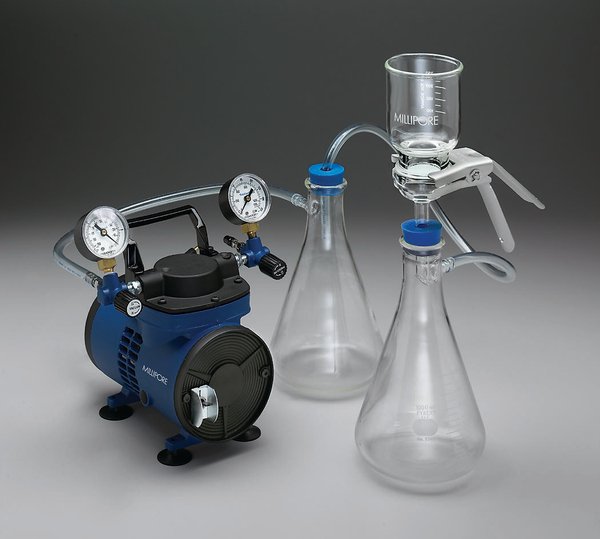
In chromatography, purity begins before the first injection.
One of the most overlooked yet critical steps is the filtration of buffer solutions used in the mobile phase.
Why is it important?
Removes particulate matter: Prevents column blockage, protects pump seals, and extends instrument life.
Enhances baseline stability: Eliminates micro-particles that can cause noise or ghost peaks.
Improves reproducibility: Ensures consistent flow rates and separation efficiency.
Ideal Filter Papers for Buffer Filtration
When filtering aqueous buffer solutions, it’s crucial to use the right membrane to avoid leaching or chemical incompatibility. Common choices:
Nylon (0.45 µm or 0.2 µm) – Excellent for most aqueous buffers; low extractables.
PTFE (0.45 µm or 0.2 µm) – Best for organic solvent compatibility; hydrophobic but can be pre-wetted for aqueous use.
Cellulose Nitrate / Cellulose Acetate (0.45 µm) – Low protein binding, suitable for biological samples.
Glass Fiber Pre-filters – Ideal for high-particulate buffers before membrane filtration.
Best Practice Tip: Always degas after filtration to prevent bubble formation inside the filter and ensure a smooth mobile phase flow.
#Chromatography #HPLC #AnalyticalChemistry #QualityControl #LabBestPractices #PharmaIndustry #ResearchAndDevelopment #BufferSolution #MobilePhase #Filtration hashtag#MethodDevelopment #LaboratoryTips #PharmaManufacturing #AnalyticalScience
No answers yet.

Method validation is fundamental for ensuring the accuracy, reliability, and regulatory compliance of analytical data in pharmaceuticals, #QualityControl, R&D, and natural product analysis.
1. #Specificity
How to Perform: Inject blank, placebo, standard, and sample solutions.
What to Evaluate: Confirm there's no interference at the analyte’s retention time.
Applicable Instruments: HPLC, LC-MS, GC, etc.
2. #Linearity
How to Perform: Prepare at least five concentrations (e.g., 80%, 90%, 100%, 110%, 120%).
What to Evaluate: Plot concentration vs. peak area, and calculate the correlation coefficient (R² ≥ 0.995).
Applicable Instruments: HPLC, UV, etc.
3. #Accuracy / #Recovery
How to Perform: Spike known amounts of standard into the sample at three levels (e.g., 80%, 100%, 120%).
What to Evaluate: %Recovery = (Detected / Added) × 100
Acceptance Range: 98–102% for APIs
Replicates: Three per level
4. #Precision
Repeatability (Intra-day): Analyze six replicates of the same concentration on the same day.
Intermediate Precision (Inter-day): Repeat on different days, using different analysts or instruments.
What to Evaluate: %RSD should be ≤ 2%
5. Limit of Detection (LOD)
How to Perform: Use the formula LOD = 3.3 × (σ/S), where σ = standard deviation of the response, and S = slope.
Alternative Approach: Use a signal-to-noise ratio of 3:1.
✔️ 6. #LimitOfQuantitation / #LOQ
How to Perform: LOQ = 10 × (σ/S)
Alternative Approach: Signal-to-noise ratio of 10:1
More stringent than LOD
7. #Range
How to Determine: Based on results from linearity, accuracy, and precision studies.
What to Evaluate: Must cover 80–120% of the target analyte concentration.
⚙️ 8. #Robustness
How to Perform: Slightly vary method parameters:
• Mobile phase pH ± 0.2
• Flow rate ± 0.1 mL/min
• Column temperature ± 2°C
What to Evaluate: Ensure %RSD and retention time remain within acceptable limits.
9. #Ruggedness
How to Perform: Conduct analysis under varying conditions:
• Different analysts
• Different instruments
• Different laboratories
What to Evaluate: Results should remain consistent (%RSD ≤ 2%)
✅ 10. System Suitability
How to Perform: Inject system suitability solution before and during the analysis.
Key Parameters:
• %RSD (area or RT) ≤ 2%
• Theoretical plates (N) ≥ 2000
• Tailing factor ≤ 2
• Resolution ≥ 2 between critical peaks
These validation parameters are the foundation of reliable results in #HPLC, LC-MS, and other analytical techniques.
Are all these checkpoints part of your method validation workflow?
#QualityControl #MethodValidation #AnalyticalScience #ICHQ2 #PharmaTesting #MethodVerification #RegulatoryCompliance
No answers yet.
Mobile App
Get the app for mobile access