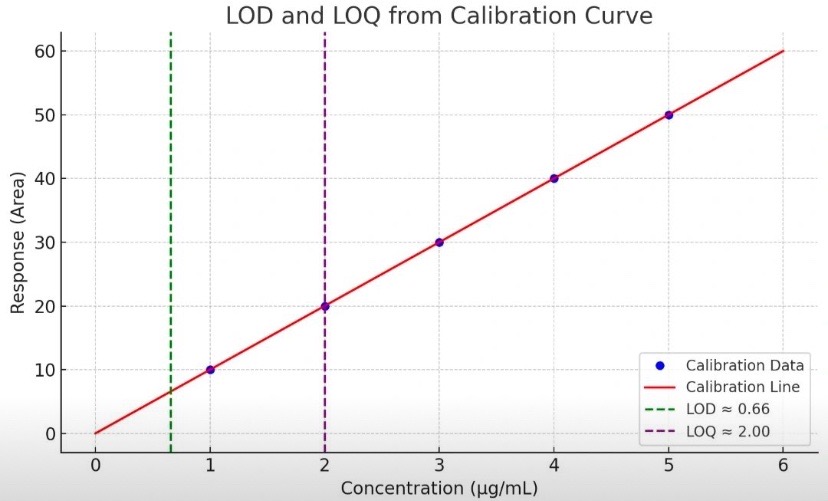
Why Spike Impurities Below LOQ in Method Validation (Related Substances – Accuracy Studies)?

During HPLC method validation for related substances, spiking impurities at levels below the LOQ may seem unnecessary—since values below LOQ are “not quantifiable.” However, this practice is critical for proving the sensitivity, robustness, and reliability of the method.
Purpose of Spiking Below LOQ
Detection Capability (LOD Check): Confirms impurities can still be distinguished from baseline noise at trace levels.
Specificity Verification: Ensures no interference from the API or excipients.
Regulatory Compliance: Meets ICH Q2(R1) requirements for sensitivity and selectivity.
Consistency Near Threshold: Assesses precision (%RSD) around detection limits, confirming method reliability.
Example
LOQ = 0.05%
Spike at 0.03% (below LOQ) → A reproducible peak should appear, demonstrating real detection capability.
Accuracy Studies – Spiking Levels
If the specification limit = 0.1%:
50% level → 0.05%
100% level → 0.10%
150% level → 0.15%
Adding a spike below LOQ (e.g., 0.03%) reinforces evidence of sensitivity.
Spiking Matrices
Placebo: Essential for assessing matrix interference.
API Solution: Supports selectivity data.
Finished Product: Best representation of real conditions.
Precision at Trace Levels
Although values below LOQ aren’t quantifiable, replicate injections (e.g., n=6) with and without spiking enable %RSD evaluation, confirming absence of random noise at trace levels.
⸻
Conclusion
Spiking below LOQ is not about quantifying impurities—it’s about demonstrating the method’s ability to consistently detect, discriminate, and remain stable at the lowest relevant levels. This builds scientific confidence and strengthens data integrity beyond regulatory compliance.
#PharmaceuticalAnalysis #HPLC #MethodValidation #ICHGuidelines #QualityAssurance #DrugImpurities